There is something about geodesic domes that messes with our minds. They are so beautifully round and symmetric looking that they seem to cast a spell on us and make us think that they are made of equilateral triangles.
Let’s explore the geodesic dome at the New Children’s Museum in San Diego (NCM):
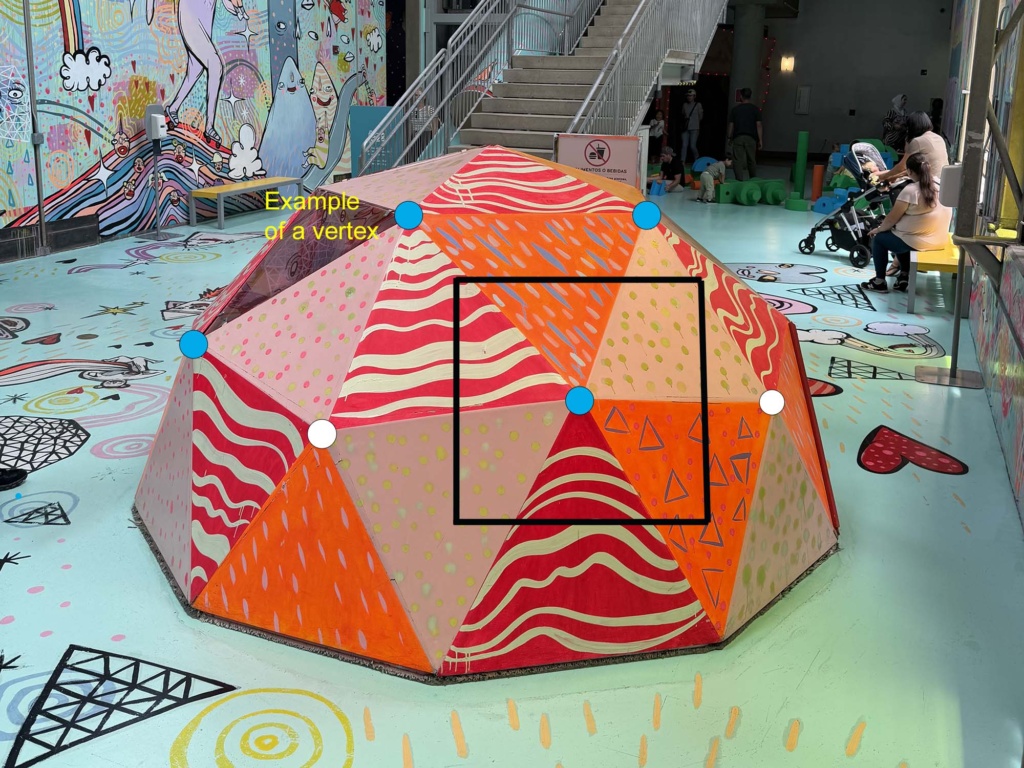
One of the first things I noticed about it was that the number of triangles meeting at the vertices (or corners) is either 5 or 6. We call these vertices of order 5 or vertices of order 6, and they are denoted in the picture above by white dots or blue dots, respectively. Let’s take a closer look at the vertex of order 6 inside the black border. That vertex looks like the top of an open umbrella. In other words, the triangles around it don’t lie completely flat.
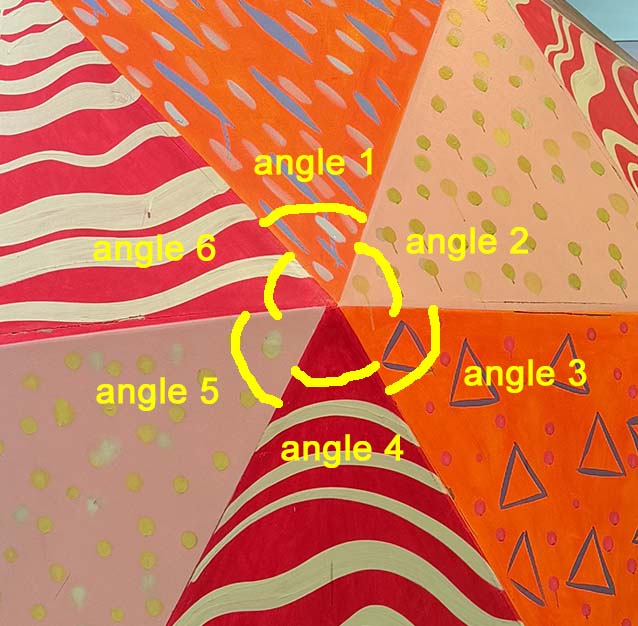
The sum of the degrees of angles 1-6 cannot possibly be 360 degrees –otherwise they would all lie flat. Since 6 x 60 =360 degrees, some of the 6 angles MUST measure less than 60 degrees. This is how we know that not all the triangles are equilateral.
So what is the reasoning behind choosing these triangle dimensions so that the entire structure looks so sphere-like? Most geodesic domes start out with the regular (meaning made of equilateral triangles) icosahedron as the basis for the design:
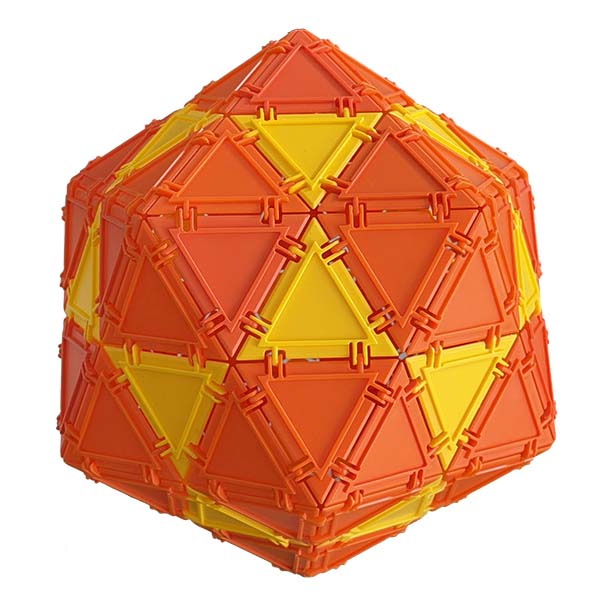
In some cases, they don’t modify the icosahedron at all, except for removing the bottom “cap”– like this structure.
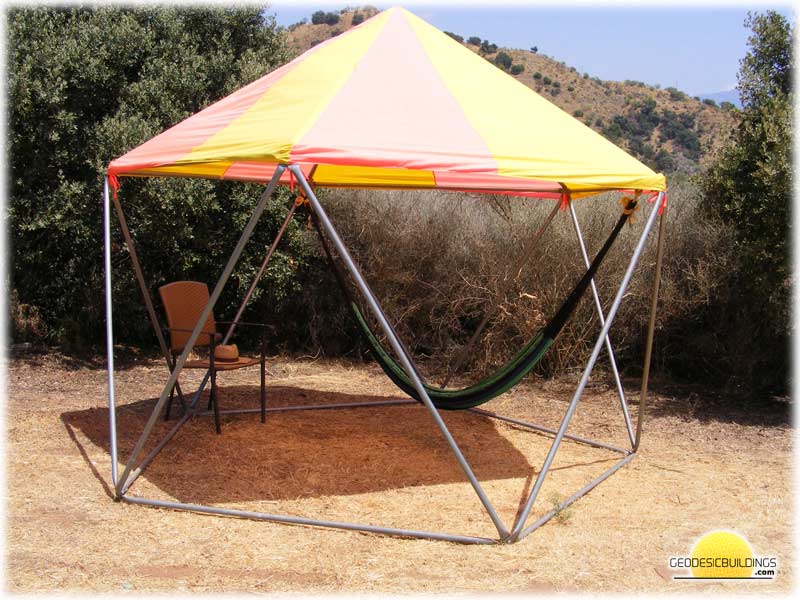
In most cases, however, people want the “round” look for their geodesic dome, both for aesthetics and greater structural stability. Is the geodesic dome at the NCM also an icosahedron?
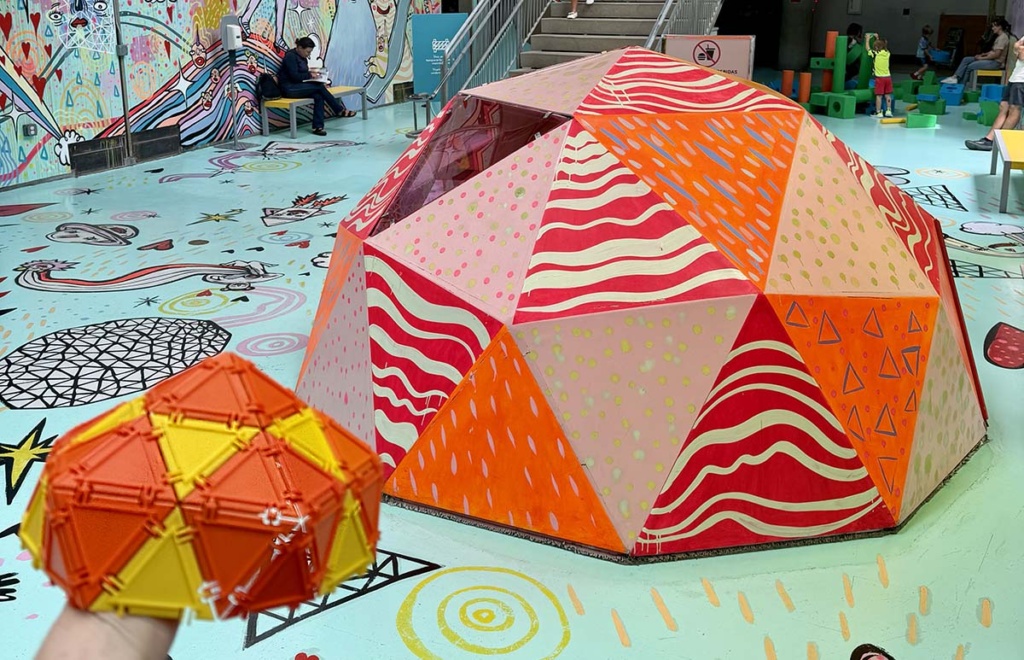
Not quite, but they are related in a way that’s not obvious. It’s all in this video:
Here is the list of steps in the video.
- Subdivide each face of the icosahedron into 4 equilateral faces.
- Draw an imaginary sphere circumscribing the icosahedron.
- Extend the inner (yellow) faces so that their vertices lie on the sphere. Note that in this process the yellow faces remain equilateral triangles (albeing somewhat larger than they started out) but the orange faces become isosceles triangles. In terms of edge length, there are now 2 edge lengths in the entire figure: the side lengths of the yellow triangles and the longer lengths of the orange triangles. This is why they call it a frequency 2 dome.
As you might imaging, the more triangles you subdivide the icosahedral faces into, the closer the geodesic dome will look to a sphere. A great example is the Epcot Center in Florida, arguably the most famous geodesic dome in the world. The next time you encounter a geodesic dome, take a closer look and see what you observe.