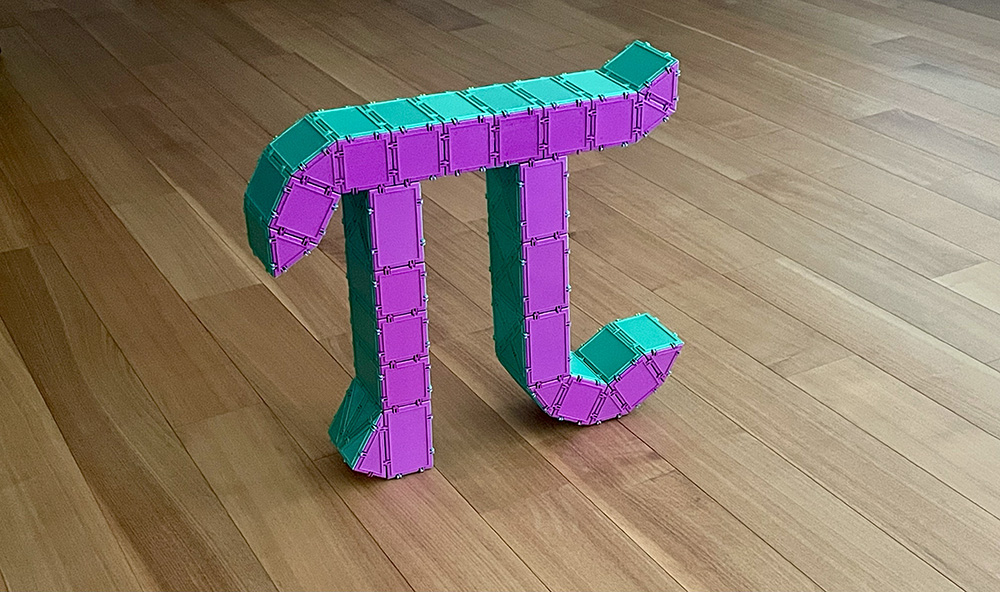
Pi, the ratio of a circle’s circumference to its diameter, is arguably the most famous irrational number. An irrational number is a number which cannot be written as a ratio of two integers. Irrational numbers have infinite decimal expansions that don’t follow any pattern. Another well-known irrational number is the Golden Ratio:
It occurred to me that the Geometiles Pi is a mini-paean (no pun intended) to several of these irrational numbers. Before going on, it is important to state that the Geometiles rectangles are Golden Rectangles, meaning that the ratio of their length to width is the above-mentioned golden ratio. Now that we got that out of the way, have a look at the “legs” of the Pi:
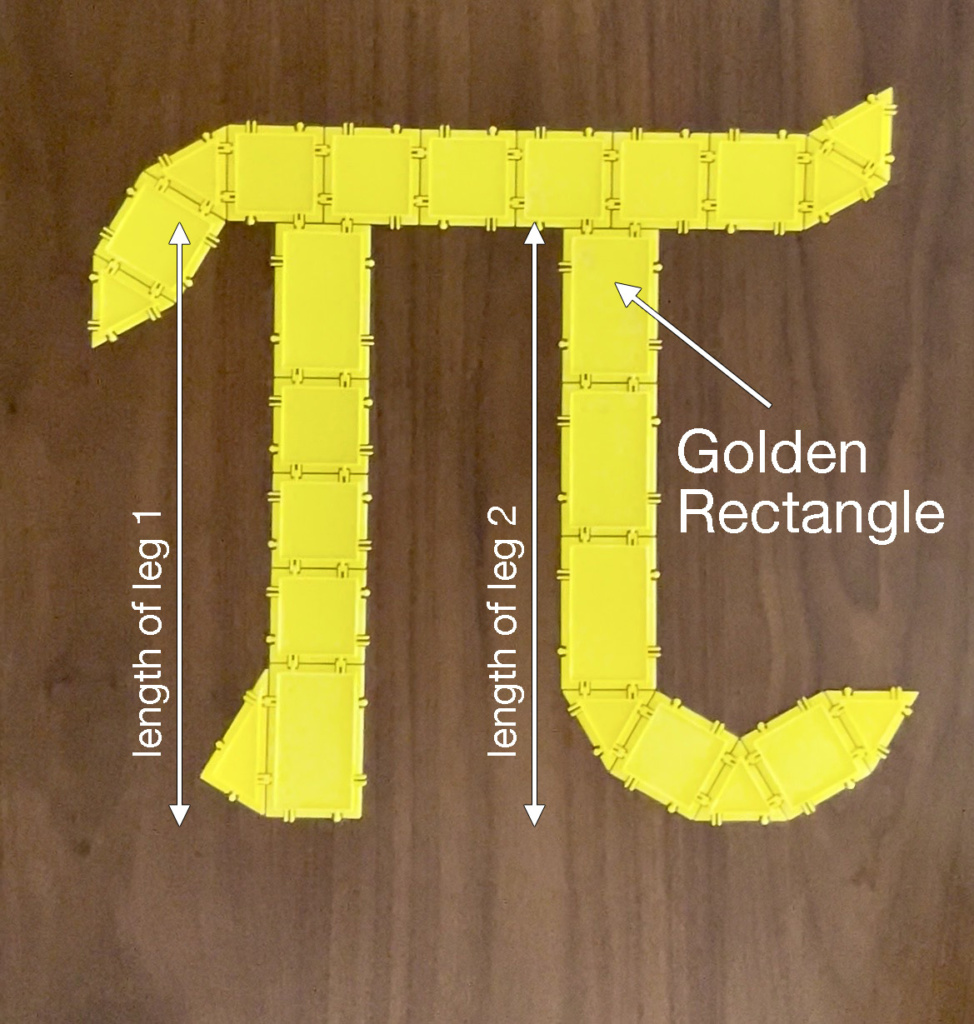
They look like they are roughly the same length, but are they? Assuming that the side length of a square is 1 unit, what are the lengths of the two legs?
Let us know in the comments or send us a quick note. The answer will be posted on this blog by the end of March 2026.
Oh, and the phrase “irrational exuberance” is due to a mathematician of sorts: Alan Greenspan, the former Chairman of the Federal Reserve, who happens to have turned 100 years old at the time of this writing. With a Ph.D. in economics and a serious interest in music, Dr. Greenspan undoubtedly has a flair for mathematics. He wasn’t talking about rational numbers when he coined this famous phrase, but Pi Day is a good occasion to repurpose it.
If you wanted to construct this Pi, here is how to do it: