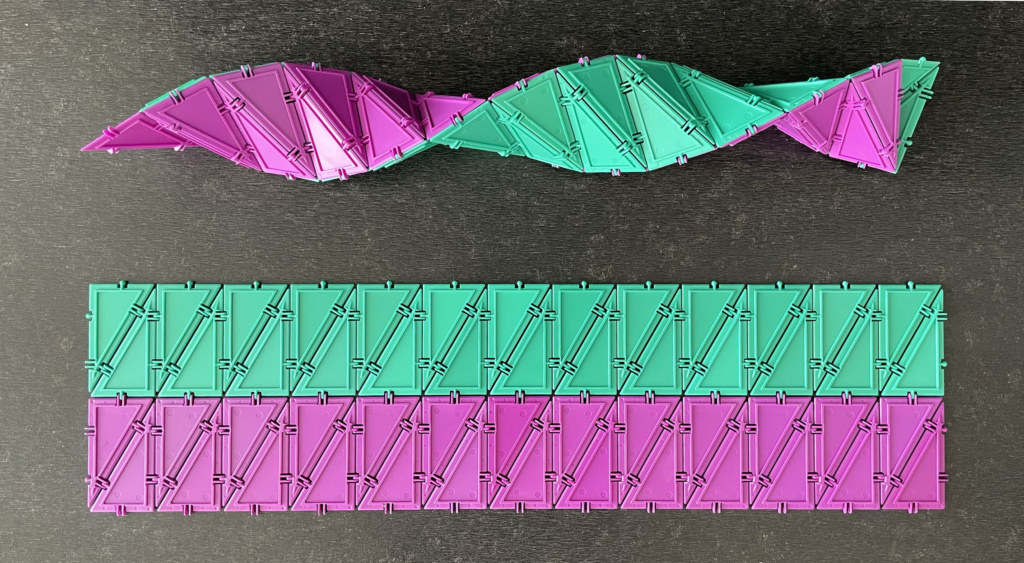
In my recent blog about the 2025 AIM Math Fair at Caltech, I wrote about an anesthesiologist who was playing around with the Geometiles 30-60-90 triangles and came up with this shape:

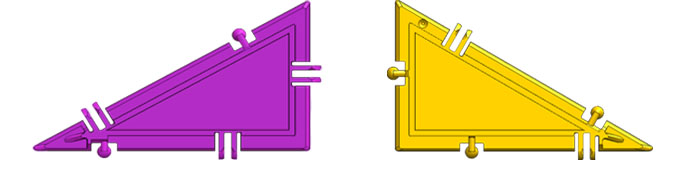
It reminded her of the origami technique of folding heart stents as they are inserted into patients’ arteries. When I saw the shape, all I could think of was how to modify her idea so that the shape actually holds together. She was using only one type of Geometiles 30-60-90 triangle (purple on the left, below), and I knew that the both types in the picture below would be needed.
After some noodling around I came up with this:

Looking at the above images , you can see how rectangular strip on the left end is gradually transformed into the elegant helical form at the extreme right. I had never seen this polyhedron before. It turns out that this is a tetrahelix, a type of cylindrical polyhedron. It is easier to understand the reasoning behind the name if we first look at a version of this polyhedron made of equilateral triangles.
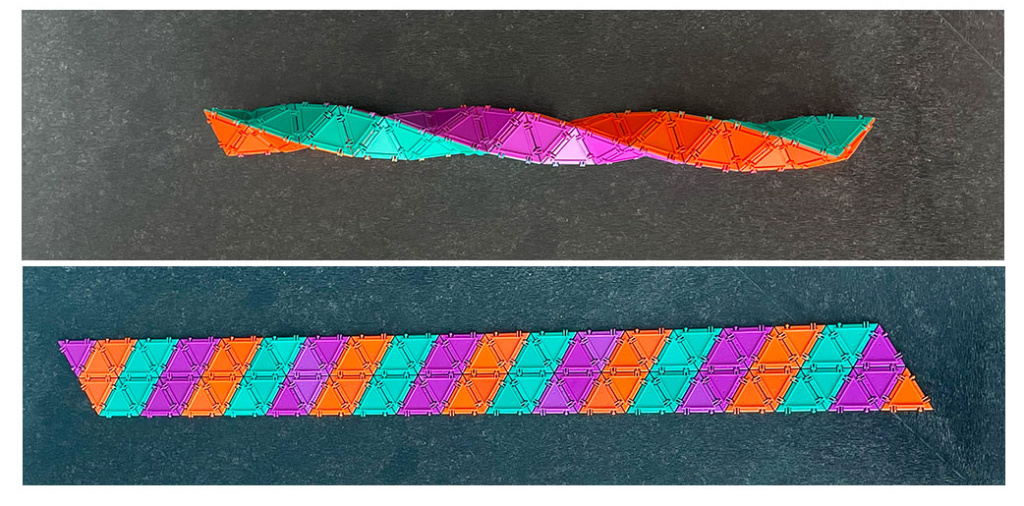
The Boerdijk-Coxeter helix is so interesting that it got its own blog. For now, have a look at the two pictures below. Can you see that these two strips are just stretched out version of each other?

The respective tetra helices made from them (below) are also stretched out versions of each other!

Both of these tetrahelices are called uniform because their vertices are symmetry equivalent.
While the 3-color model of the scalene tetrahelix eases the comparison to the regular tetrahelix, I feel that aesthetically it is not the optimal coloration. To me, the 2-color model is both easier to construct and better at conveying the elegance of the shape. This is what is shown in the main image of this blog. Due to the uniformity of this helix, it rotates very smoothly and makes a lovely spinner. I put a rope along its length with a tree pod at the end and set it spinning. The is the result. It also shows how to make it.